No products in the cart.
10
Aug

Matching Your Veil to Your Dress and Hair
Everyone obsesses over length, but honestly, the neckline of your dress and how you’re wearing your hair can matter just as much. A veil that’s technically the “right” length can still look off if it’s fighting with a low back or squashing a curled updo.
Necklines and Backs
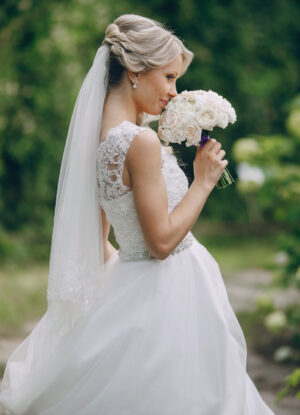
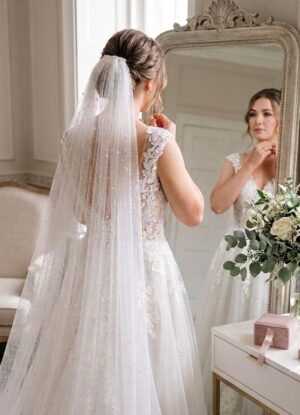
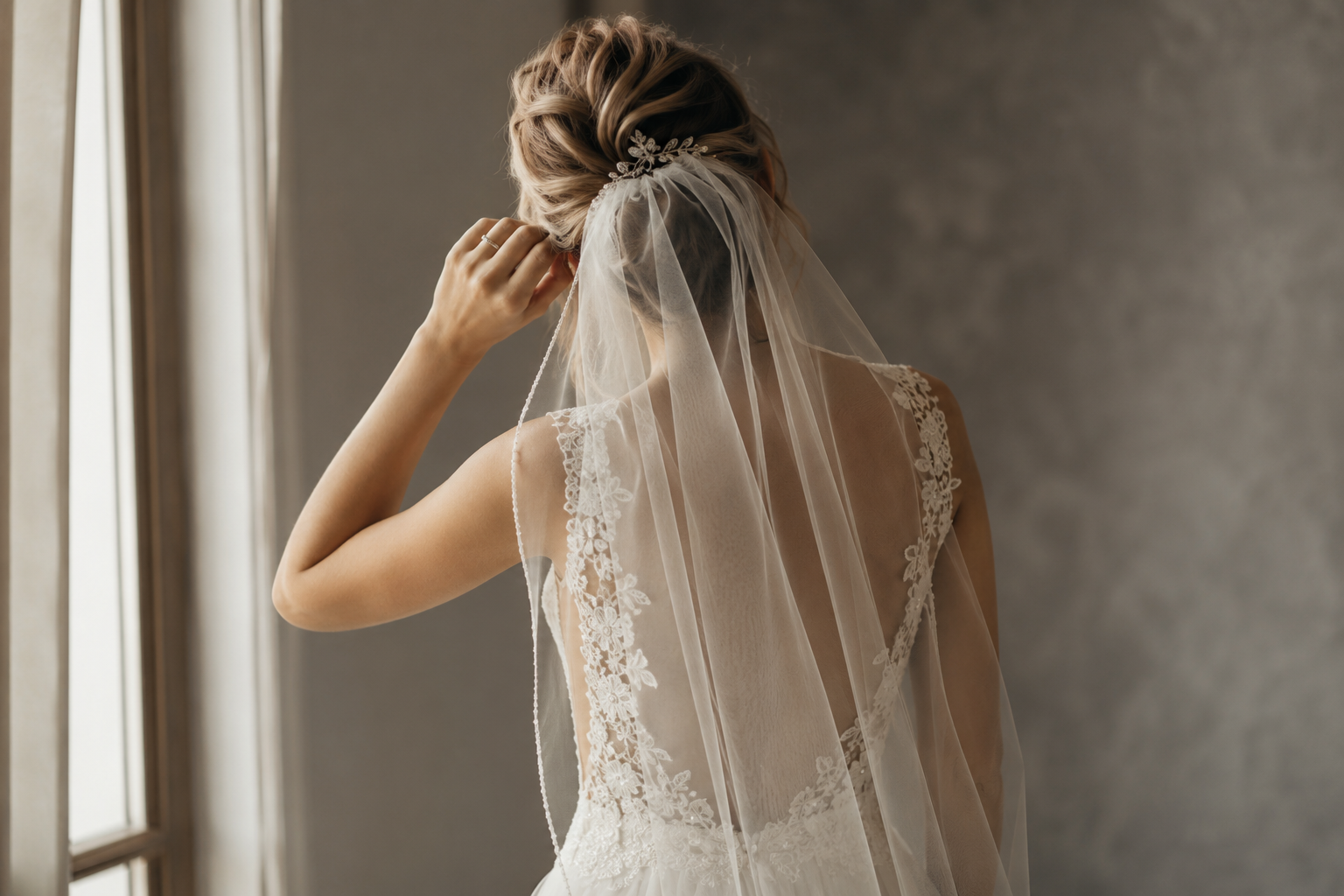
Open or low-back dresses — lace panels, buttons down the spine, illusion mesh — deserve a veil that doesn’t bury all that under a pile of tulle. A fingertip veil is light enough that the back of the dress still shows through, which is honestly half the reason it’s the most popular length out there.
Same logic applies to off-shoulder and strapless cuts. Keep it simple, let the neckline do its job. An elbow veil works well here — enough presence, not enough to compete.
Full, closed-back dresses with a train are a different situation. There’s nothing to hide, so this is exactly where a cathedral veil makes sense — it just continues the line the train already started.
Sleeves and Detailed Bodices
Long sleeves, puffed shoulders, heavy beading — the dress is already saying a lot. Adding a huge dramatic veil on top can tip it into too much. An elbow or floor veil usually sits better in that case.
If the dress is on the plainer side — clean lines, not much lace — a longer veil can actually do the heavy lifting instead. A chapel or royal veil can make a simple gown feel a lot more dramatic without needing extra beading or embroidery to get there.
Hair Changes Things More Than People Expect
Updos — buns, twists, braids — are the easiest to work with. A comb sits securely and the veil can go under or over the style depending on how much height you want at the crown.
Hair worn down is trickier. A bulky veil can flatten curls or waves, so something lighter and single-layer tends to look better, especially at fingertip or floor length.
Half-up styles land somewhere in between — enough structure to hold a veil, enough looseness that the hair still moves.
One Veil for the Whole Day, or a Switch Later?
More brides these days are planning two looks — something long and formal for the ceremony, then swapping to shorter (or nothing at all) once the dancing starts. If that’s the plan, a cathedral or royal veil for the aisle, then a fingertip or bare head for the reception, gets you the drama in photos without wearing it through an entire evening of hugging relatives.
Basically
Work with what the dress and hair are already doing, not against it. Bare back, delicate neckline — stay light, go fingertip. Full train, closed back — let a cathedral veil run with it. Busy sleeves or a loud bodice — go shorter. Hair down — go lighter. It’s not about more fabric, it’s about the right amount for what you’ve already got on.