No products in the cart.
23
Jul


Wedding Veil Length Guide: Which One Fits You
Most brides spend weeks agonizing over the dress and then pick the veil in the last ten minutes before checkout. It’s understandable — there are so many lengths, and none of them are labeled with what they actually look like on a real body in a real venue. A cathedral veil sounds grand until you realize your ceremony is in a living room. A fingertip veil sounds practical until you’re standing next to a floor-length ballgown wondering if it’s even doing anything.
So here’s the length-by-length version, written the way we’d explain it to a friend standing in our shop trying to decide.
Cathedral Veil
The cathedral veil is the one that trails several feet past the dress. If you’ve pictured yourself walking down a long aisle with fabric pooling behind you, this is that image. It belongs at big church weddings, cathedrals, and anywhere with high ceilings and enough room for a proper entrance.
It pairs naturally with ballgowns and A-line dresses that already have a train of their own — the two should move together, not compete. A cathedral veil on a very short, simple dress can look mismatched, so this is really a decision made alongside the gown, not after it.
We wrote a longer piece just on this one, with exact lengths and how to wear it: What Is a Cathedral Veil and How Long Should It Be?
Royal Veil
If cathedral length still feels too modest, there’s the royal veil — longer again, the kind you see in actual royal wedding photos. It only really makes sense in venues built to handle it: cathedrals, grand halls, estates with long aisles. In a smaller space it stops being elegant and starts being logistics.
Chapel Veil
The chapel veil lands just short of cathedral length, usually skimming the floor and just past it. It has almost the same formal feel without quite as much fabric to manage, which makes it a good compromise if you want the “long veil” look but don’t want to think about a bustle-adjacent situation all evening.
It works well with mermaid and fit-and-flare dresses, where a bit of extra length at the back balances out the fitted silhouette up top.
Floor Veil
The floor veil does exactly what it says — ends right at the floor, no extra trailing. It’s the length that gets recommended most often when someone says “I want it long but I don’t want to deal with a train.” It suits nearly any dress and doesn’t ask much of the wearer beyond normal care.
Fingertip Veil
The fingertip veil ends where your hand does, arms relaxed at your sides. This is the one most brides land on, mostly because it works with almost everything — A-line, ballgown, mermaid — and it’s short enough to dance in without anyone stepping on it by 9pm.
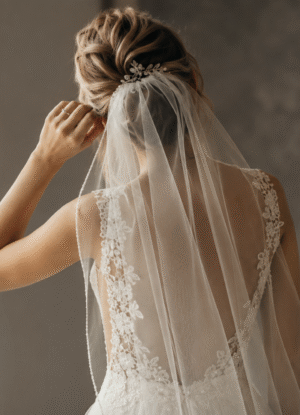
It also tends to sit at a length where back details on the dress (buttons, lace, an open back) still show through the tulle instead of disappearing behind it.
We go into actual measurements and width options here: Fingertip Veil Length Guide
Elbow Veil
The elbow veil is shorter still, ending around the elbow. It’s light, it stays out of the way, and it keeps attention on the top half of the dress — which matters if you’ve got a statement neckline or sleeves you don’t want a long veil covering up.
Matching Length to the Actual Wedding
A few things worth asking yourself before you buy:
How formal is the venue? A cathedral or a grand hall can carry a cathedral or royal veil. A backyard, a courthouse, a small chapel — those usually look better with something shorter.
Does the dress have a train? Veil and train should read as one line, not two separate things happening. A long veil next to a short, trainless dress tends to look like an afterthought.
Are you keeping it on all night? If you’re dancing, hugging people, and generally moving around for hours, fingertip or elbow length will save you a lot of trouble compared to anything that drags.
What’s the general mood you’re going for? Traditional and formal weddings tend to pull toward longer veils. Relaxed, outdoor, or modern ones usually don’t need that much fabric to feel complete.
Veils for US Weddings, by Venue
American weddings happen in wildly different settings, and the venue is often the real deciding factor:
Church or cathedral ceremonies with a long aisle suit a cathedral veil or royal veil — there’s enough space for them to actually do something.
Courthouse weddings and small civil ceremonies usually work better with a fingertip or elbow veil, simply because there’s less room and less formality to match.
Backyard and garden weddings — grass, wind, uneven ground — are easier with something shorter, like fingertip, elbow, or a floor veil that doesn’t need constant adjusting.
Ballroom and hotel receptions can handle a chapel or floor veil comfortably, giving that formal feeling without needing the full cathedral sweep.
The Right Length Is the One You Feel Best In
There isn’t a correct answer here, just the one that matches your dress, your venue, and how much you actually want to think about your veil once the ceremony’s over. Whether that’s the sweep of a cathedral veil, the everyday practicality of a fingertip veil, or something shorter and out of the way, the goal is the same: pick it once, then stop thinking about it and enjoy the day.