No products in the cart.
18
Nov


When to Buy Your Wedding Veil: A 2027 Bridal Accessories Timeline
Most brides settle the dress first and leave the rest for later. That works until the veil arrives in the wrong shade, or the stylist finds that the comb can’t carry its weight. If you’re asking when to buy a wedding veil, the practical answer is soon after the dress is ordered and well before your final fitting.
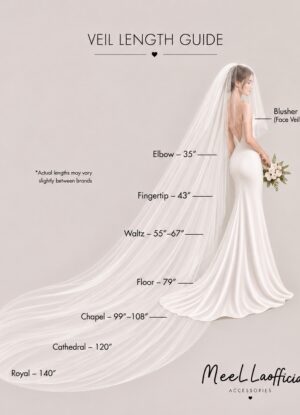
Length is the first thing to settle, because a veil built for a long aisle behaves very differently from one made for dancing. Take cathedral wedding veils, for example: they start at roughly 280 to 300 cm, so they need space, a hairstyle that can carry them, and a venue that suits their sweep.
Where the veil fits in your 2027 planning
A realistic wedding planning checklist 2027 starts with the big bookings: the date, the venue, the photographer. Dress shopping comes next, then the veil, and only then the small pieces. Accessories sit at the end of the line, yet they depend on choices made at the start, such as whether the ceremony is in a church, a garden or on a beach.
That’s why the veil shouldn’t be treated as an afterthought. It’s the one accessory that changes the silhouette of the whole look, and it’s hard to judge without the finished dress next to it. Buy it too early, and you may end up matching a gown you later change. Buy it too late, and you’ll be rushing a custom order in the weeks when everything else is also due.
How do you match a veil to your dress?
The simplest method for how to match a veil to a wedding dress is to compare three things side by side: color, fabric and level of detail. The color should match the tone of the dress closely, so take a fabric swatch or a clear photo of the gown with you. White against ivory is easy to misjudge under store lighting, and daylight tells the truth.
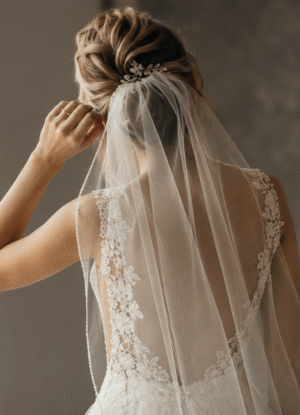
Detail is where many brides overdo it. A heavily beaded or embroidered gown usually looks best with a plain tulle veil, so the two don’t fight for attention. A minimalist dress, on the other hand, can carry a refined lace edge, delicate pearls or floral embroidery across the veil. Length matters too. A cathedral style always extends beyond the hem of the dress, which is exactly the effect you’re paying for.
How far ahead should you order?
There’s no single wedding veil shopping timeline that fits everyone, because ready-made and custom pieces move at different speeds. Custom-made veils require additional production time. At MeeLLaOfficial, we can create wedding veils in custom lengths from 90 to 500 cm to suit your preferred style and wedding dress.
Ask for the production time before you pay, then count back from your final fitting.
A good target is to have the veil in your hands before that fitting, so you can see it with the real gown and shoes. If you’re drawn to a shorter option, fingertip wedding veils reach about 43 inches (110 cm), which leaves you free to hug guests and dance without anyone stepping on the fabric.
Does your venue change the choice?
It can, as much as the dress does. Here’s how the setting usually steers the style:
- Church or large formal hall: a long veil has room to flow down the aisle.
- Beach: a floor-length veil without heavy decoration looks clean and simple by the water.
- Garden: floral motifs or pearl embellishment suit the natural backdrop.
- Hotel or banquet hall: a veil pairs nicely with a simple, straight-cut gown.
Think about the walk, too. A blusher is worn over the face before the aisle, and styles with one tend to be fuller, so mention it when you order. Embroidery can be subtle, like white thread on white, or colored to echo your wedding palette.
When do the smaller pieces come in?
Brides often wonder when to choose wedding accessories like combs, jewelry and a belt. Wait until the dress is settled and the veil is picked. The neckline tells you what jewelry will work, and the veil tells you how much the hair can take on. A veil needs a hairstyle that supports the weight of its fabric, and a comb is the usual fix for more elaborate styles.
This is also the time to book a hair trial. Bring the veil to it, not a photo of the veil. The stylist can test where it sits, how it moves and whether a tiara or decorative combs would crowd it. If they do, drop one of them. A veil usually pairs easily with a single hairpiece, and two statements rarely help.
A simple order of decisions
Here’s a bridal accessories checklist in the order most brides tackle it:
- Confirm the dress and its neckline, because the neckline decides whether earrings, a necklace or neither will work.
- Choose the veil length and color against the dress fabric, ideally in daylight.
- Book the hair trial and bring the veil, so the stylist can test the comb and how well it carries the weight.
- Pick the hair accessory, such as a tiara or decorative combs, after the veil is settled so the two don’t compete.
- Finalize jewelry, shoes and any wrap or belt after the last fitting, when the hem length is fixed.
- Pack everything in one box a week before the wedding, with a spare comb or pins for touch-ups.
Before you buy anything, write down your final fitting date, the length you want and the shade of your dress. With those three details you can compare options quickly and ask the right questions about delivery time. It also helps to ask whether a fabric sample can be sent first, so you can hold it against your gown at home.